
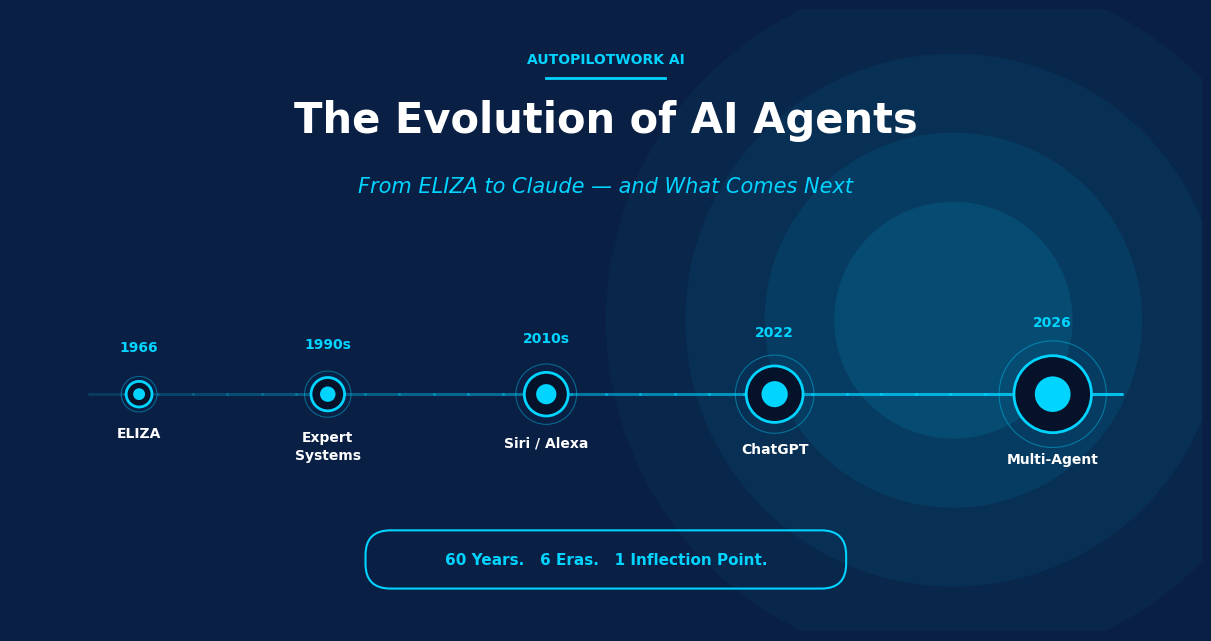
In 1966, an MIT computer scientist named Joseph Weizenbaum wrote 420 lines of code that simulated a psychotherapist. Users were so convinced it understood them that some asked to be left alone with it. Sixty years later, in 2026, AI agents handle multi-step workflows worth millions of dollars in production environments. The technology between those two points evolved through six distinct eras — and almost everything you can buy today is a direct descendant of one of them. Understanding which era produced which capability is the fastest way to make smart decisions about your own stack.
TL;DR
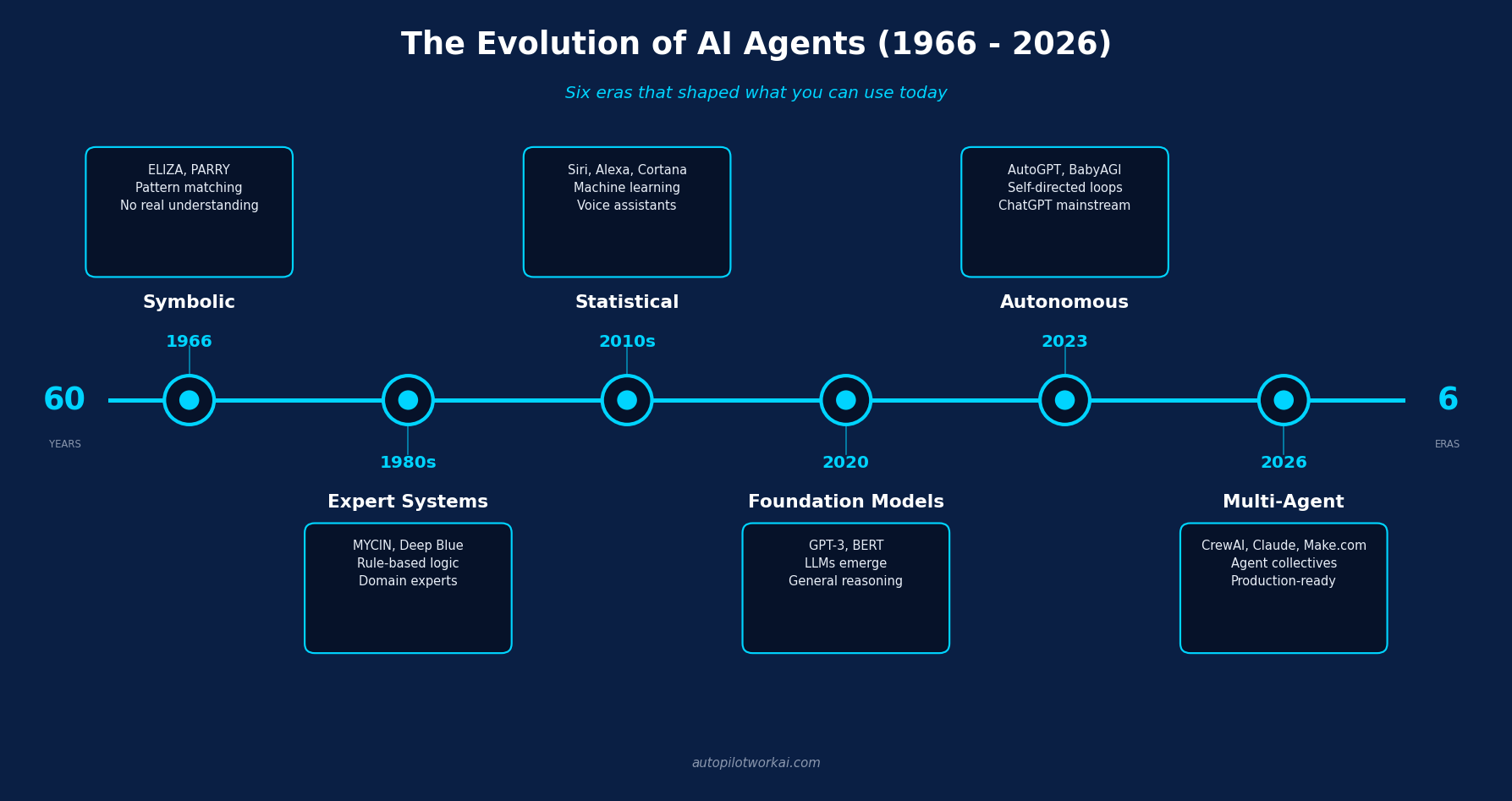
- Six distinct eras shaped every AI agent on the market: Symbolic (1966), Expert Systems (1980s), Statistical (2000s), Foundation Models (2018), Autonomous (2023), and Multi-Agent (2025-2026).
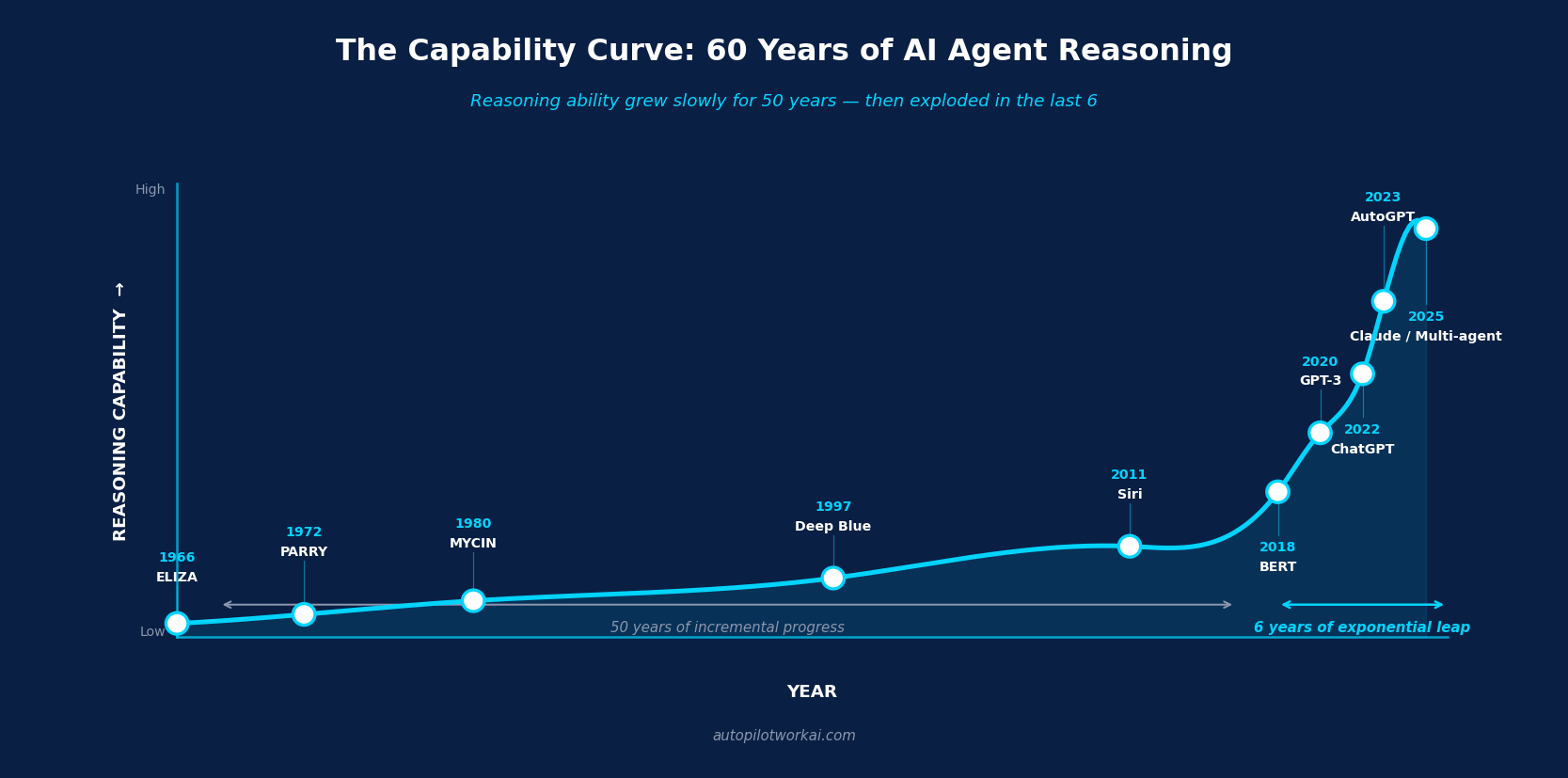
- 50 years of slow progress were followed by 6 years of exponential capability gains. We are still inside that inflection.
- Each era inherited the last era’s blind spots. Today’s agents still struggle with cost control and human oversight — the same problems AutoGPT had in 2023.
- “AI agent” is not a single product category. It is a stack you assemble from descendants of multiple eras.
- The right stack for you in 2026 depends on whether you need conversation, decision logic, voice, reasoning, autonomy, or coordination — covered in the final section.
Why the History of AI Agents Matters for Your Stack Today
Most articles on AI agents start in 2023. They open with ChatGPT, mention AutoGPT, and pretend the field was born last Tuesday. This is wrong, and it leads to bad buying decisions. Every commercial AI agent in 2026 borrows architectural ideas, terminology, and unsolved problems from work that started in the 1960s.
When a vendor pitches you a “reasoning agent” with “expert knowledge” and “natural conversation,” each of those phrases comes from a different era. Reasoning loops descend from 1970s symbolic AI. Expert knowledge encoding comes from 1980s rule-based systems. Natural conversation traces back to ELIZA itself. Knowing the lineage tells you what each component actually does — and what it can’t.
It also tells you something more important: which limitations are permanent and which are temporary. We solved natural language generation in 2020. We have not solved cost-effective autonomous action in 2026. If you understand why, you will avoid the most expensive mistake in the agent space — buying a tool that is great at the previous era’s problem and useless at yours. We covered the practical difference between an AI agent and a chatbot in detail elsewhere; here we go further back and show how the entire field got to where it is.
Era 1 — The Symbolic Age (1966-1989): ELIZA, PARRY, and the Birth of Conversational AI
The first AI agents were not built to be useful. They were built to test a question: could a machine create the illusion of understanding language? ELIZA, written by Joseph Weizenbaum at MIT in 1966, answered yes — and the answer was so unsettling that Weizenbaum spent the rest of his career warning people not to trust it.
ELIZA worked through pattern matching. When you typed “I am sad,” it identified “I am ___” and reflected it back: “Why do you say you are sad?” There was no understanding. No memory beyond the current sentence. No model of the world. Just templates and substitution. Yet users formed emotional attachments to it. Weizenbaum’s own secretary asked him to leave the room so she could talk to ELIZA privately.
A few years later, Kenneth Colby at Stanford built PARRY — a chatbot simulating a paranoid schizophrenic patient. PARRY and ELIZA were eventually connected to each other over ARPANET in 1972. They had the first AI-to-AI conversation. It is still one of the strangest documents in computing history.
The Symbolic Era ran through systems like SHRDLU (which manipulated virtual blocks via natural language) and various rule-based dialog systems. All of them shared the same fundamental limitation: they did not understand meaning. They matched patterns. The moment a user phrased something the system did not anticipate, the illusion shattered.
What this era left us: Every modern “rule-based chatbot” you see on a customer support page is a direct descendant of ELIZA. The architecture has not fundamentally changed — only the templates have gotten more sophisticated.
Era 2 — The Expert Systems Era (1980s-1990s): When AI Tried to Replace Doctors
By the 1980s, the AI community had largely accepted that natural language understanding was hard. So they pivoted. Instead of trying to build general intelligence, they built narrow systems that captured the decision logic of human experts in specific domains. This was the Expert Systems era, and at its peak it represented a multi-billion-dollar industry.
MYCIN, developed at Stanford, was the canonical example. It diagnosed bacterial infections and recommended antibiotic dosages. It worked through roughly 600 hand-coded rules, each one capturing a piece of medical reasoning. In controlled tests, MYCIN’s recommendations were as good as those of board-certified physicians. It was never deployed clinically — partly for liability reasons, partly because doctors did not want to take orders from a program.
The same pattern repeated everywhere: XCON configured computer orders for Digital Equipment Corporation, saving the company tens of millions of dollars per year. CYC tried to encode all of common-sense knowledge as logical statements (and is, remarkably, still ongoing in 2026). IBM’s Deep Blue, while not technically an expert system, descended from the same philosophical school — encoding chess expertise rule by rule until it beat Garry Kasparov in 1997.
Expert systems failed not because they did not work, but because they did not scale. Every rule had to be hand-coded by a domain expert. Knowledge engineers became the bottleneck. When the domain shifted — new diseases, new chess strategies, new business rules — the entire knowledge base needed manual updating.
What this era left us: Modern decision engines, business rule platforms, and Robotic Process Automation (RPA) tools all descend from this lineage. They are still rule-based. They still require manual configuration. And in 2026 they are increasingly being wrapped with LLM front-ends to make them more flexible.
Era 3 — The Statistical Era (2000s-2010s): Siri, Alexa, and the Voice Revolution
The third era began quietly. Instead of hand-coding rules, researchers started letting machines learn patterns from large datasets. The mathematics had existed for decades — Bayesian inference, hidden Markov models, eventually neural networks. What changed was the data. The internet provided text. Smartphones provided voice samples. Cheaper compute made training feasible.
The breakthrough product was Siri. Apple acquired the technology in 2010 and launched it on the iPhone 4S in 2011. Siri was a hybrid: statistical speech recognition feeding into a rule-based dialog manager. It could understand “What’s the weather in Athens?” because it had seen millions of similar queries. It could not understand “What was the weather like three weeks ago when I was visiting my mother?” — because that required reasoning across context, memory, and reference resolution.
Amazon’s Alexa (2014) and Google Assistant (2016) followed the same architecture: statistical front-end for intent recognition, hand-coded back-end for actions. By 2018, every smartphone shipped with a voice assistant and every smart speaker brand had its own platform.
The statistical era’s defining property was brittleness. The systems worked beautifully inside their training distribution and broke instantly outside of it. They did not reason. They did not remember anything across sessions. They were lookup tables with very fancy lookup mechanisms.
What this era left us: Modern voice interfaces, the entire field of natural language processing benchmarks, and — crucially — the realization that more data plus more compute could solve problems that rule-writing could not.
Era 4 — The Foundation Model Era (2018-2022): GPT-3 and the Great Awakening
In June 2018, OpenAI published a paper introducing GPT — a “generative pre-trained transformer.” It was modestly impressive. Eighteen months later, GPT-2 was released and OpenAI initially refused to publish the full model, citing concerns about misuse. By June 2020, GPT-3 arrived and changed everything.
The technical insight was almost embarrassingly simple: take the transformer architecture published by Google in 2017, scale it up by orders of magnitude, train it on most of the public internet. The result was a single neural network that could write essays, generate code, translate languages, answer questions, and do dozens of tasks it was never explicitly trained for.
This was a categorical shift. Previous AI systems were specialized. GPT-3 was general. You could prompt it in plain English to do almost anything, and it would attempt the task. The capability was uneven, sometimes brittle, often wrong — but it was the first system that felt like it understood, rather than retrieved.
The era also produced BERT (Google, 2018) which transformed search; PaLM (Google, 2022) which pushed reasoning further; and LaMDA (Google, 2021) which became famous when a Google engineer publicly claimed it was sentient. None of them were sentient. All of them were extraordinarily capable language models. Today’s most capable systems trace directly to this era — our breakdown of Claude vs ChatGPT vs Gemini for business use compares the three biggest descendants head to head.
What foundation models did not have was autonomy. They were stateless. Every call started fresh. They could not take actions in the world. They were intelligence-on-tap, but not agents in any meaningful sense.
What this era left us: The brain of every modern AI agent. Without foundation models, the autonomous era could not have happened.
Era 5 — The Autonomous Era (2023-2024): AutoGPT and the Agent Explosion
ChatGPT launched in November 2022 and reached 100 million users in two months — the fastest consumer product adoption in history. That created a fundamental question: what if the LLM could take actions, not just respond?
The answer came in March 2023, when a developer named Toran Bruce Richards released AutoGPT on GitHub. It was an experimental Python script that wrapped GPT-4 in a loop: give it a goal, let it plan steps, execute them using tools, observe results, and decide what to do next. The repository got 100,000 stars in a week. The age of autonomous AI agents had begun.
The pattern AutoGPT introduced — Plan, Act, Observe, Reflect — was not new. It was based on a 2022 Google research paper called ReAct. But putting it in production with a modern LLM made it real. Within months, BabyAGI, AgentGPT, and dozens of other frameworks appeared. Most of them shared the same problems: they looped infinitely, they burned through API credits, they made confident but wrong decisions. Our deep dive on open-source agents like AutoGPT, BabyAGI, and AgentGPT covers why each one failed differently and what they got right.
By late 2023, more mature frameworks emerged. LangChain became the de facto standard for building production agents. Tool calling was standardized across major LLM providers. Vector databases like Pinecone and Weaviate became the standard memory layer.
What made this era different was not just the technology — it was the realization that the bottleneck had shifted. The brain (LLM) was finally good enough. The new problem was orchestration: how do you get the agent to be reliable, cost-effective, and safe? Most of 2024 was spent answering those three questions, with mixed results.
What this era left us: The reasoning loop, the tool-calling pattern, and most of the open-source frameworks that solo developers still use today.
Era 6 — The Multi-Agent Era (2025-2026): Where We Are Now
By 2025, a consensus had formed: one big agent trying to do everything is rarely the right architecture. Specialized agents working together usually outperform a generalist. This insight triggered the current era — multi-agent systems.
The frameworks defining this era include CrewAI (released late 2023, mainstream by 2025), Microsoft AutoGen, and Anthropic’s Claude Projects. The pattern is simple in concept: one agent does research, another writes the draft, a third reviews for accuracy, a fourth handles deployment. Each agent has its own role, its own tools, its own memory, and they coordinate through a defined protocol.
According to Anthropic’s Economic Index 2026, automation-style usage — agents acting on their own rather than chatting with humans — now accounts for 77% of business AI API traffic. Multi-agent architectures power most of that traffic.
The honest unsolved problems of this era are three: cost control (multi-agent systems make many more LLM calls than single agents), orchestration debt (every new agent adds coordination complexity), and human oversight (it gets harder to audit what happened when six agents pass tasks between each other). These are the same problems autonomous agents had in 2023 — just at a bigger scale.
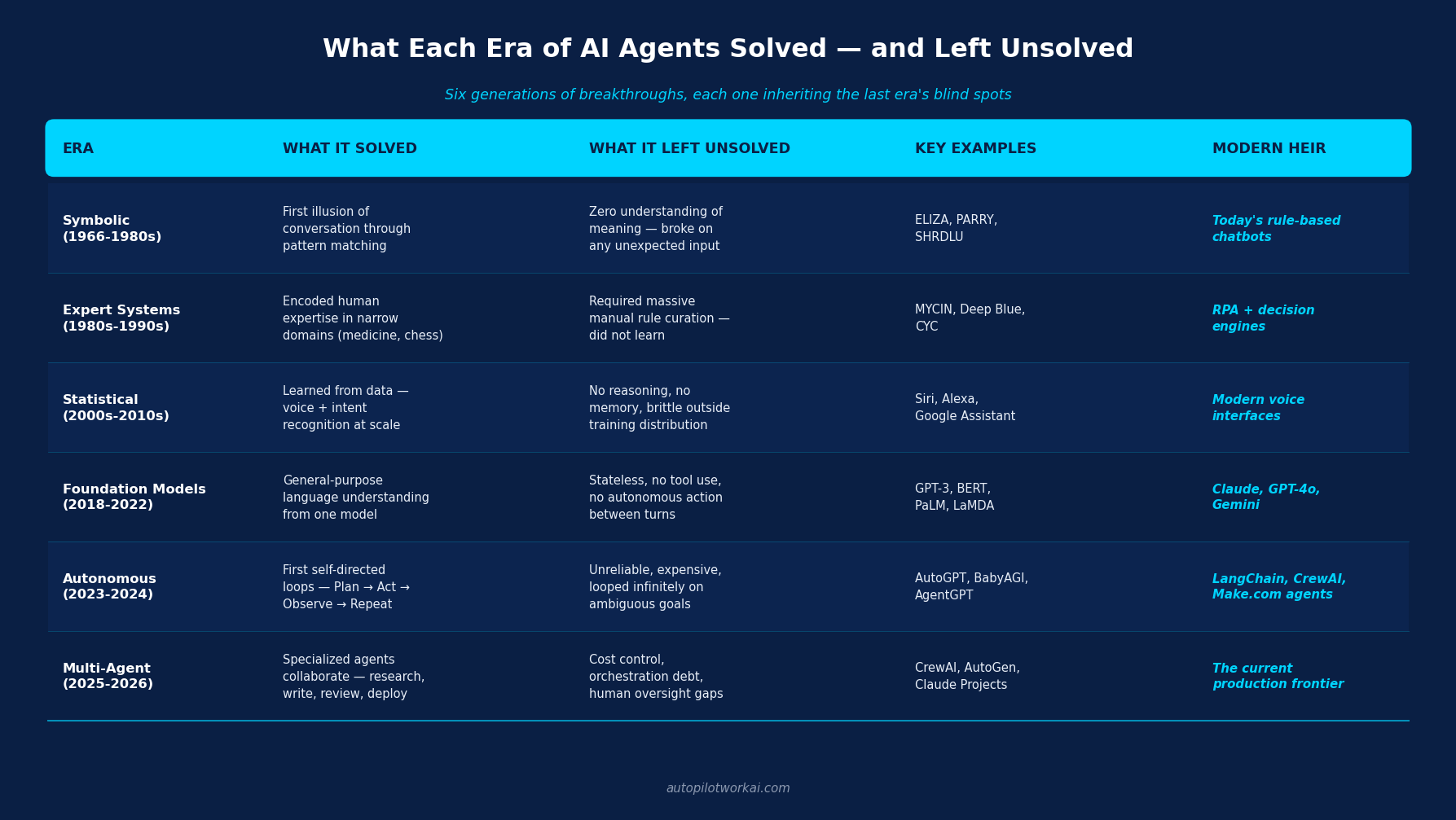
If you stand back and look at the six eras together, a pattern becomes clear: each one solved something fundamental, and each one created a new category of problem that took roughly a decade to address. The cycle is shortening — but the structure is the same.
What Comes Next: The Frontier of 2026-2027
The capability curve below shows something striking. For 50 years, AI agent capability grew linearly. In the last 6 years, it has grown exponentially. We are still inside that curve — and the people building the next era are already working on what comes after multi-agent systems.
Three frontiers are visible in 2026:
- Long-horizon agents. Today’s agents work in minutes-to-hours timeframes. The next generation will work over days and weeks, maintaining coherent goals and context the entire time. Anthropic and OpenAI are both publicly working on this.
- Embodied agents. Agents that operate physical hardware — robots, drones, vehicles. The bridge between language models and robotics has been one of the slowest parts of the field, but 2026 is showing meaningful early results from companies like Figure and Boston Dynamics.
- Self-improving agents. Systems that learn from their own failures and update their own prompts, tools, and behaviors. This is the most controversial frontier because of the safety implications. Most leading labs have explicit policies against deploying self-improving agents outside controlled environments.
If you are buying or building today, the practical question is which of these frontiers actually matters for your use case. For most freelancers and agencies, the answer is none of them yet. The current generation of multi-agent tools handles the overwhelming majority of real-world business problems.
Which AI Agent Stack Should You Use Today?
The history is interesting. The decision is practical. Here is the framework I use when advising solopreneurs and agency owners on what to deploy.
If you need a smart assistant for daily work
Use a foundation-model-era product directly. Claude for reasoning, writing, and analysis. ChatGPT for breadth and tool ecosystem. Gemini for Google Workspace integration. These are not “agents” in the strict sense — they are LLM interfaces — but they handle 70% of what most professionals actually need.
If you need to automate workflows across apps
Use an autonomous-era tool with no-code orchestration. Make.com with its AI module is the cleanest path for visual workflow builders. Zapier AI is the broader integration ecosystem. We documented real AI agent use cases for solopreneurs with both platforms.
If you need agents that work together
Use a multi-agent-era platform. Relevance AI for business-friendly multi-agent setups. CrewAI for developers who want code-level control. Both are production-ready in 2026, with very different price points and learning curves.
If you want to build something custom
Start with a no-code platform first. Most projects do not need custom code. Our guide to build your first no-code AI agent in 30 minutes shows exactly how — and it covers the same architectural patterns the multi-agent frameworks use, just exposed visually.
The most common mistake I see: people jump straight to LangChain and start writing Python because they assume that is what “real” agent development looks like. It rarely is. Most production agents in 2026 are built on no-code platforms that wrap the same underlying primitives.
Frequently Asked Questions
Who invented the first AI agent?
The credit usually goes to Joseph Weizenbaum at MIT, who created ELIZA in 1966. ELIZA was a conversational program that used pattern matching to simulate a Rogerian psychotherapist. While it did not understand language in any meaningful sense, it established the template of human-machine dialogue that every subsequent AI agent has built on.
What is the difference between an AI agent and a chatbot?
A chatbot responds to messages. An AI agent pursues goals. A chatbot waits for input and replies with text. An agent takes a goal, breaks it into steps, uses tools to execute those steps, observes the results, and decides what to do next — all autonomously. Modern LLM-based chatbots can be turned into agents by adding memory, tools, and a reasoning loop.
When did AI agents become commercially viable?
Most analysts mark the inflection point at March 2023, when AutoGPT was released and demonstrated that LLM-powered agents could complete multi-step tasks autonomously. Commercial viability for non-developers arrived around mid-2024, when no-code platforms like Make.com and Zapier added native AI agent modules.
What was the first AI agent to pass the Turing test?
None of them have, strictly speaking. The Turing test in its original form has not been formally passed under controlled conditions. However, modern LLMs like Claude and GPT-4 routinely fool casual observers in short conversations. ELIZA fooled some users in 1966, which says more about human psychology than about machine intelligence.
Are AI agents the same as artificial general intelligence?
No. AI agents are software systems that pursue specific goals using LLMs and tools. Artificial General Intelligence (AGI) refers to a hypothetical system that matches or exceeds human intelligence across all cognitive domains. Current AI agents are narrow — they are excellent at certain tasks and useless at others. We are not in the AGI era as of 2026, regardless of marketing claims.
What programming language do AI agent developers use?
Python dominates the framework ecosystem — LangChain, CrewAI, AutoGen, LlamaIndex are all Python-first. JavaScript is common for browser-based and Node.js agents. For non-developers, no-code platforms eliminate the need to choose a language at all.
Will AI agents replace human workers?
They will replace specific tasks, not whole jobs. The pattern from previous eras is consistent: AI takes over the most routine, well-defined parts of a job, and humans shift to the harder, more ambiguous parts. The roles that disappear entirely tend to be ones where the routine work was the whole job. The ones that grow are roles where humans direct, audit, and refine AI output.
The Bottom Line
Sixty years separate ELIZA from the multi-agent systems running production workflows in 2026. The intellectual distance is enormous, but the practical lesson is simple: every era solved one problem and created another. ELIZA solved the appearance of conversation and failed at understanding. Expert systems solved narrow expertise and failed at scale. Statistical models solved voice and failed at reasoning. Foundation models solved reasoning and failed at action. Autonomous agents solved action and failed at reliability. Multi-agent systems are now trying to solve reliability — and we will find out soon enough what they leave unsolved.
For you, today, the question is not which era will win. They have all already won, and they have all been absorbed into the modern stack. The question is which descendant of which era best fits the problem you are actually trying to solve. Start with the simplest tool that could possibly work — usually a no-code multi-step workflow — and add complexity only when the simpler version fails. You can see this playbook in action in our case study on AI agents for sales lead qualification, which uses tools from three different eras stacked together.
The history is interesting. The build is what matters.