

TL;DR — Which Open-Source AI Agent Should You Pick?
-
- AutoGPT: Best for technical users wanting full autonomy with web and code access. Powerful but expensive in API credits.
-
- BabyAGI: Best for researchers and system designers studying task planning. Excellent reasoning, weak execution.
-
- AgentGPT: Best for non-technical users wanting to try agents in a browser. Easiest setup, but sessions are fragile.
-
- The honest 2026 take: All three are increasingly dated. For production work, frameworks like CrewAI or managed platforms outperform them.
-
- For non-developers: A no-code Zapier or Make.com workflow beats all three for 80% of solopreneur use cases.
Affiliate Disclosure: This article contains affiliate links. If you purchase through these links, AutoPilotWork AI may earn a commission at no extra cost to you. Every tool recommended here has been personally tested in real-world workflows.
What AutoGPT, BabyAGI, and AgentGPT Actually Are
Before comparing them, it helps to understand what they actually share. All three are open-source frameworks that wrap a large language model — typically OpenAI’s GPT — in an autonomous loop. The user provides a goal, the LLM breaks it into sub-tasks, the framework executes those tasks one by one, stores results in memory, and decides whether to continue or stop based on whether the goal is reached. This pattern is fundamentally different from a chatbot like ChatGPT, which simply responds to one prompt at a time. We’ve covered this distinction in detail in our breakdown of AI agents vs chatbots vs automation — the key difference is that agents pursue goals iteratively across multiple steps, while chatbots react to single prompts. What separates the three projects is the orchestration layer — how the loop is structured, what tools are available at each step, and how user-friendly the interface is. The diagram below shows the architectural differences at a glance.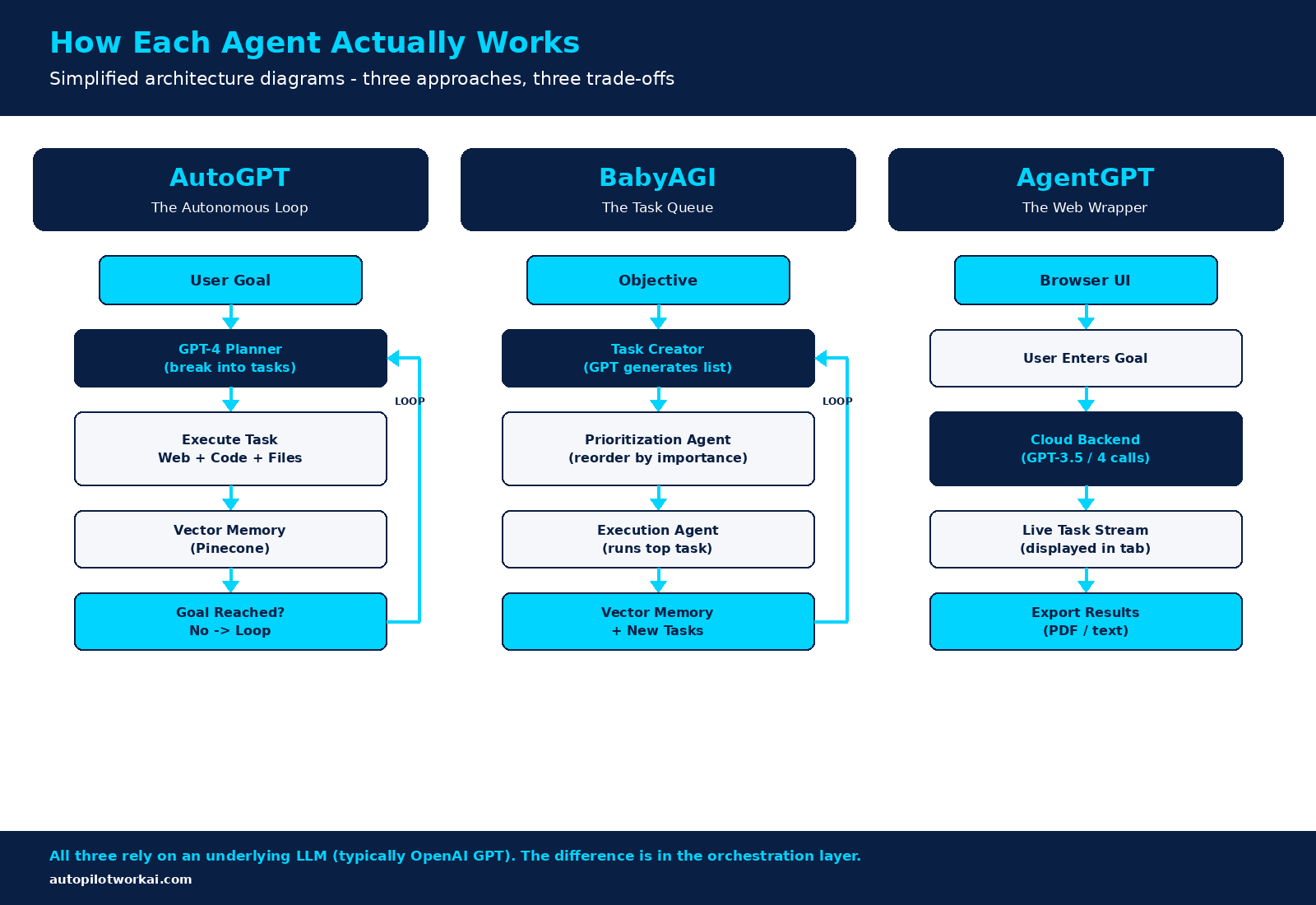
AutoGPT vs BabyAGI vs AgentGPT: Head-to-Head Comparison
The matrix below summarizes the key trade-offs across all three frameworks. Each column captures a single tool’s strengths and limitations across the dimensions that actually matter when picking one.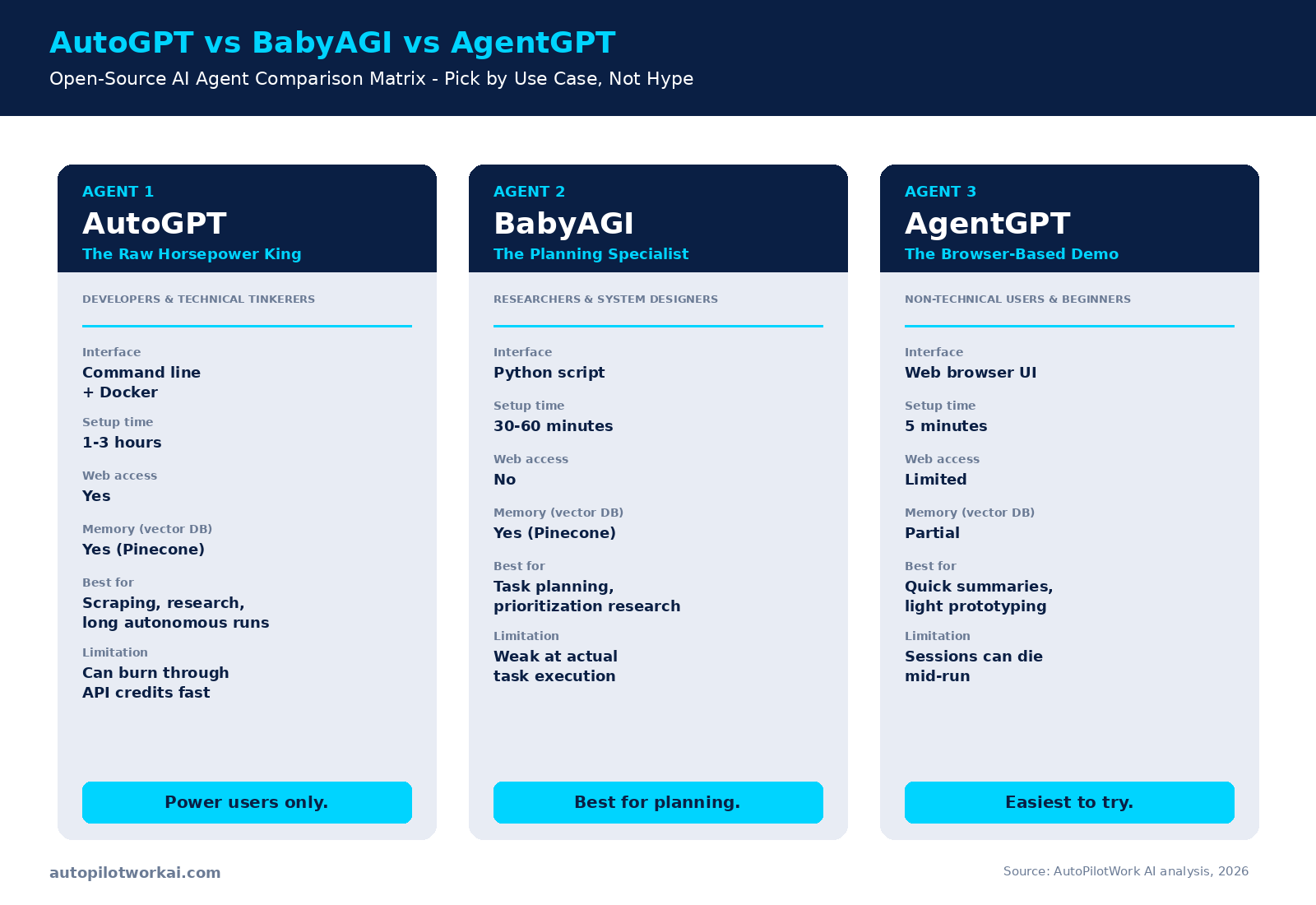
AutoGPT: The Raw Horsepower King
Created by Toran Bruce Richards and released in March 2023, AutoGPT became the fastest-growing open-source project in GitHub history by star count — crossing 100,000 stars within months of launch. It distinguished itself early by giving the AI agent direct access to the internet, the ability to read and write files, and the option to execute code, making it the most capable of the three out of the box.Where AutoGPT Wins
AutoGPT shines when the task requires real-world data and tool use. Scraping competitor websites, generating market research reports, writing and testing code, or running long autonomous workflows overnight — these are the workloads where AutoGPT genuinely delivers. The built-in Google Search API integration and file system access let it handle problems that BabyAGI and AgentGPT simply cannot reach. Setup is straightforward for anyone comfortable with a terminal: clone the GitHub repository, install Python dependencies, set up an OpenAI API key with sufficient credits, and configure the .env file. Expect about one to three hours for a first-time setup if you’ve never worked with Docker before.Where AutoGPT Struggles
The most common complaint about AutoGPT is API cost. Because the agent makes many GPT calls per iteration and often loops dozens of times before completing a goal, users report burning through $5 to $20 of API credits on a single complex task. Production use at scale requires careful prompt design and aggressive task scoping to keep costs manageable. The second issue is reliability. AutoGPT can occasionally get stuck in repetitive loops, hallucinate tool outputs, or misinterpret task completion. For experimental work this is acceptable. For production workflows where consistency matters, it’s a real limitation — one that newer frameworks have addressed more effectively.BabyAGI: The Planning Specialist
Created by Yohei Nakajima in April 2023 as a minimal Python script, BabyAGI took a different design philosophy. Where AutoGPT bundles autonomous tool use into a single loop, BabyAGI splits the work across three distinct agents: a Task Creation agent generates new sub-tasks from the objective, a Prioritization agent reorders them by importance, and an Execution agent runs the top-priority task. Results feed back into a vector database (typically Pinecone) for long-term memory.Where BabyAGI Wins
BabyAGI is at its best when the task is fundamentally about planning — breaking a complex objective into a coherent, well-ordered sequence of sub-tasks. Researchers, system designers, and educators consistently rate it higher than AutoGPT for interpretability and structured task decomposition. The agent loop is small enough to read in a single afternoon, which makes it ideal for teaching, demos, and academic study. BabyAGI is also less prone to the “wandering” failure mode that plagues AutoGPT. Because the prioritization step happens explicitly between task generation and execution, the agent maintains focus on the original goal more reliably across long runs.Where BabyAGI Struggles
BabyAGI’s biggest weakness is execution. The framework doesn’t natively support web access, file I/O, or code execution — it generates and prioritizes tasks well, but actually doing them requires either custom extensions or human follow-through. Many experienced users report that the most productive workflow is using BabyAGI to generate a rigorous task list, then handing that list to a specialist tool or a human to execute. The community around BabyAGI is also smaller than AutoGPT’s, which means fewer plugins, fewer tutorials, and slower bug fixes. For anyone building a no-code AI workflow, the recommended path is different entirely — our guide on building an AI agent without code covers a more practical alternative.AgentGPT: The Browser-Based Demo
AgentGPT took a fundamentally different approach: instead of asking users to install Python or work with Docker, the creators built a polished web interface where you enter a goal, watch the agent reason and act, and export results — all in a browser tab. The agent itself follows an AutoGPT-style loop, but the user experience is fully cloud-hosted and accessible to anyone.Where AgentGPT Wins
AgentGPT is unmatched for accessibility. A non-technical user can land on the homepage, enter “Plan a three-day weekend in Lisbon” or “Summarize the key arguments for and against four-day workweeks,” and have a usable output within minutes. No installation, no API key configuration, no Python environment — just a browser and a goal. This makes AgentGPT the natural entry point for anyone curious about AI agents but unwilling to invest the setup time AutoGPT demands. It’s also useful for quick prototyping — testing whether an agent-based approach makes sense for a use case before committing to a more serious framework.Where AgentGPT Struggles
The web-based architecture cuts both ways. Sessions can die mid-run when browser tabs crash, when the cloud backend times out, or when free-tier limits are reached. Users frequently report agents hanging at “99% complete” with no way to recover the partial work. The export feature should always be used as soon as useful output appears, rather than waiting for the agent to declare itself finished. AgentGPT also has limited tool access compared to AutoGPT. Web browsing, file persistence, and code execution are either restricted or absent in the free tier, which means complex multi-step workflows requiring real-world data tend to fail.Decision Flowchart: Which AI Agent Should You Actually Pick?
The choice between the three depends on four questions: your technical comfort level, your need for autonomy, your use case, and whether you should consider a 2026 alternative instead. The flowchart below walks through the decision in under a minute.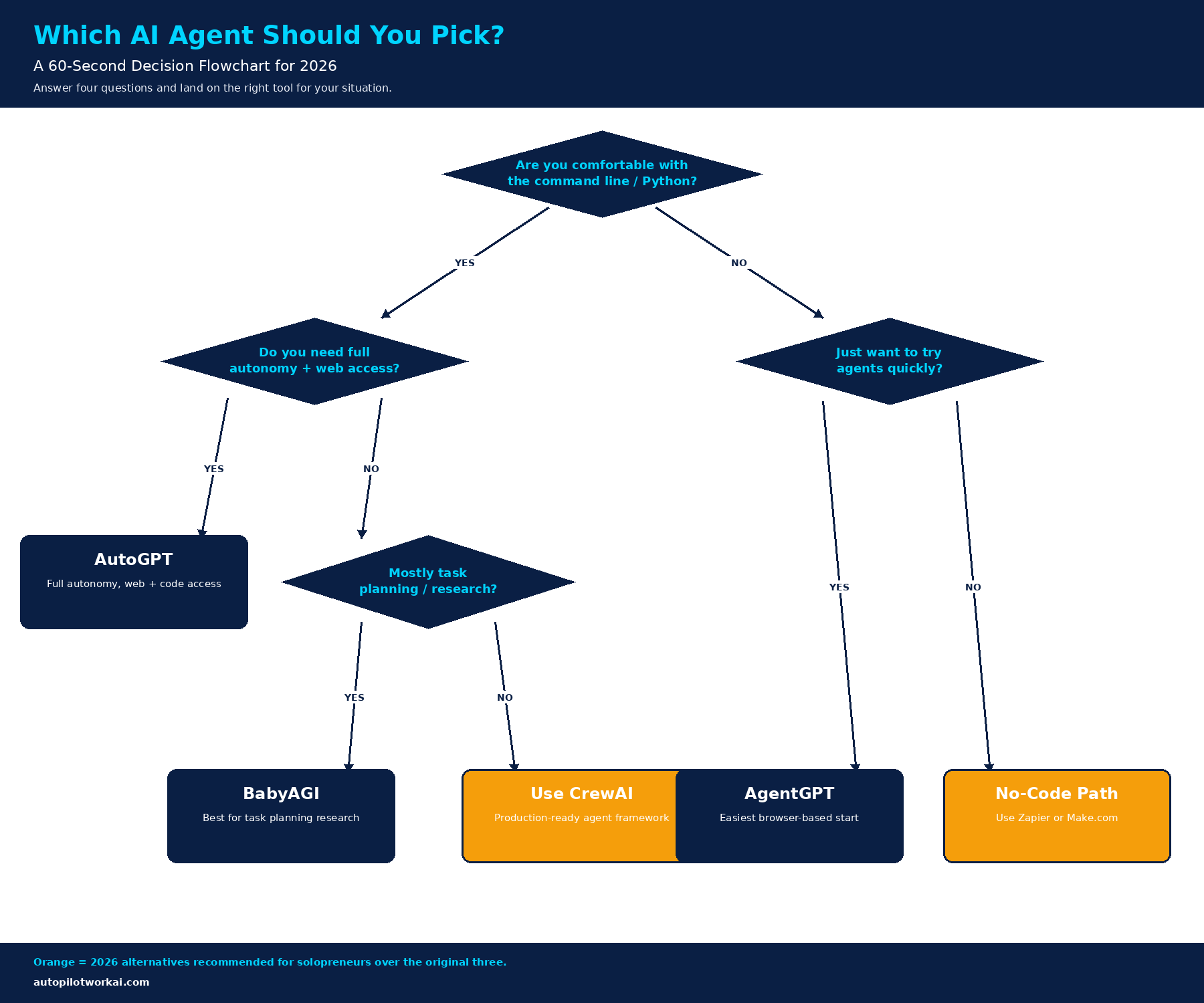
API Costs and Which LLM to Use Underneath
All three frameworks are LLM-agnostic in theory, but performance varies dramatically by model. AutoGPT and BabyAGI were originally designed around OpenAI’s GPT-4, and most users report unreliable behavior when downgrading to GPT-3.5 — more loops, more hallucinated outputs, more abandoned tasks. For 2026, the practical recommendation is to use Claude Sonnet or GPT-4o as the backbone for any serious agent work. Both models offer strong reasoning, reliable tool calling, and competitive pricing. For a detailed performance comparison across business tasks, our Claude vs ChatGPT vs Gemini for business test covers the trade-offs. Expect to spend $2 to $10 per non-trivial agent run on GPT-4o, and $1 to $5 on Claude Sonnet for equivalent workloads. BabyAGI runs cheaper than AutoGPT because it makes fewer LLM calls per iteration. AgentGPT’s pricing depends on whether you use their free tier (limited to about two minutes per run on GPT-3.5) or plug in your own API key for unrestricted access.The Honest 2026 Take: When You Should Skip All Three
Three years after launch, the original generation of open-source AI agents has been substantially outpaced by newer frameworks. AutoGPT, BabyAGI, and AgentGPT remain valuable for learning, experimentation, and specific niche use cases — but if you’re starting a serious project in 2026, several alternatives deserve consideration first.CrewAI for Production Agent Work
CrewAI has emerged as the leading open-source framework for multi-agent orchestration. Where AutoGPT runs a single agent in a loop, CrewAI lets you define multiple specialized agents with distinct roles, tools, and goals — then coordinates handoffs between them. For complex workflows requiring division of labor (a researcher agent, a writer agent, an editor agent), CrewAI is meaningfully more capable than any of the original three.LangChain Agents for Maximum Flexibility
LangChain provides a comprehensive agent framework with battle-tested abstractions for memory, tool integration, and orchestration. The learning curve is steeper than AutoGPT, but the resulting agents are more reliable and easier to debug. For developers building production agent systems, LangChain remains the industry standard.No-Code Automation for Non-Developers
For solopreneurs and small business owners, the most honest recommendation is often the simplest: skip agents entirely and use a no-code automation platform. Zapier with Claude or GPT integrations can handle 80% of the tasks people reach for AI agents to solve — without the reliability issues, the API cost surprises, or the setup overhead. For a head-to-head between the two leading no-code platforms, our Make.com vs Zapier comparison for solopreneurs breaks down which fits which use case.Real-World Use Cases by User Persona
Rather than abstract feature comparisons, the most useful way to pick between these tools is by user persona. Below are the realistic use cases where each framework genuinely shines.-
- The technical solopreneur scraping data: AutoGPT, configured with specific scoping prompts to limit API costs, handles weekly competitor monitoring and content research effectively.
-
- The researcher studying agent behavior: BabyAGI’s clean architecture makes it ideal for instrumenting and analyzing how prioritization affects task completion rates.
-
- The curious non-developer: AgentGPT in a browser tab, with the export button bookmarked, gives a hands-on introduction to agent reasoning without setup overhead.
-
- The content creator building AI workflows: None of the three is the right choice. Our roundup of the best AI agents for content creators covers more practical, purpose-built alternatives.
-
- The agency building production agent systems: Skip all three. Start with CrewAI or LangChain — they’re more reliable, better documented, and actively maintained.
Frequently Asked Questions
Is AutoGPT still being actively developed in 2026?
Yes, AutoGPT continues active development on GitHub under the Significant Gravitas organization, with regular commits and a maintained roadmap. However, the pace of innovation has slowed compared to 2023, and the project increasingly competes with newer frameworks like CrewAI and managed platforms. For experimentation and learning it remains relevant; for production systems, evaluate alternatives carefully.Which is the cheapest to run: AutoGPT, BabyAGI, or AgentGPT?
BabyAGI is typically cheapest because it makes fewer LLM calls per iteration and lacks web browsing (which adds many GPT calls to each AutoGPT run). AgentGPT’s free tier costs nothing but is limited to about two minutes per run. AutoGPT is the most expensive at scale — expect $5 to $20 in API costs for a complex multi-hour autonomous run.Can I use these agents without an OpenAI API key?
Yes, all three support alternative LLMs through configuration changes. AutoGPT and BabyAGI both support Claude and other models via LangChain or direct API integration. Performance varies — Claude Sonnet performs competitively with GPT-4o for most agent tasks, while smaller open-source models like Llama 3.1 often struggle with the multi-step reasoning agents require.Are open-source AI agents safe to use with sensitive data?
The agents themselves run locally (AutoGPT and BabyAGI) or in cloud sessions (AgentGPT), but they all send prompts and data to whichever LLM provider you configure. Sensitive data exposure depends on the LLM’s data policies — OpenAI and Anthropic both offer business APIs with explicit no-training guarantees. For truly sensitive workloads, consider self-hosted LLMs like Llama 3.1 running on your own infrastructure.What’s the easiest way to try an AI agent without installing anything?
AgentGPT is the simplest entry point — visit the web app, enter a goal, and watch the agent run in your browser. No installation, no API key required for basic free-tier use. Sessions are short and capabilities are limited, but it’s a five-minute way to understand what AI agents actually do before investing time in AutoGPT or alternatives.Is CrewAI really better than AutoGPT for production use?
For most production workflows, yes. CrewAI was designed with multi-agent coordination, role specialization, and reliability as first-class concerns from the beginning. AutoGPT was originally an experimental proof-of-concept that has been retrofitted toward production over time. CrewAI’s documentation, examples, and community support for production deployments are noticeably stronger as of 2026.Can BabyAGI work without a vector database like Pinecone?
Technically yes, but the experience degrades significantly. Without a vector database for long-term memory, BabyAGI loses context between iterations and starts to repeat or contradict its own earlier tasks. Free alternatives like Chroma or FAISS can substitute for Pinecone if cost is a concern, but some form of vector storage is essentially required for non-trivial runs.The Bottom Line
AutoGPT, BabyAGI, and AgentGPT each represent a different philosophy for autonomous AI agents — raw capability, structured planning, and accessible UX, respectively. None of them is universally the right choice. Pick AutoGPT if you’re technical and need full autonomy with tool access. Pick BabyAGI if you’re studying or teaching agent architectures. Pick AgentGPT if you want to try agents in five minutes with zero setup. But pick none of them blindly. The 2026 landscape includes more mature options — CrewAI for production, LangChain for flexibility, and no-code platforms for non-developers — that often deliver better results with less effort. The right answer depends on who you are and what you’re trying to accomplish, not on which framework had the biggest GitHub launch. Have a specific use case in mind and not sure which to pick? Drop your scenario in the comments below — I’ll suggest the framework that actually fits your situation.About the Author: Emmanouil Mavratzotis is the founder of AutoPilotWork AI. He helps freelancers, solopreneurs, and agency owners save time and scale their business through AI tools and workflow automation. Every recommendation on this site comes from real-world testing and practical implementation.