
According to Salesforce’s State of Sales report, the average sales rep spends only 28% of their week actually selling. The rest goes to data entry, lead research, and qualifying leads who never had a chance to close. For solopreneurs and small agencies, that math is fatal — you don’t have the headcount to waste hours chasing the wrong people. This is exactly where AI agents for sales lead qualification change the game in 2026: they handle enrichment, scoring, and routing automatically, so you only talk to leads worth your time.
TL;DR — The Bottom Line Up Front
- AI agents for sales lead qualification have moved from enterprise-only to solopreneur-affordable in 2026.
- Best overall for solopreneurs: Apollo.io (free tier + AI scoring built-in).
- Best for agencies scaling outbound: Smartlead + Clay combo (multi-inbox + custom enrichment).
- Best budget pick: Salesforge — full AI SDR under $50/month.
- Best for custom workflows: Lyzr (no-code agent builder for unique qualification logic).
- Setup time ranges from 2 hours (Apollo) to 1 week (Lyzr custom agents) — match the tool to your volume and skill level.
What Is an AI Sales Agent for Lead Qualification?
An AI sales agent for lead qualification is autonomous software that takes a raw lead — a form submission, a cold email reply, a LinkedIn connection — and decides whether that lead is worth a human’s time. Unlike a chatbot that only responds to questions, an agent acts on its own: it enriches the contact with firmographic data, scores fit against your ideal customer profile (ICP), checks intent signals, and routes the lead to the right next step.
The critical distinction here matters. If you’re new to this category, it’s worth a few minutes to understand the difference between an AI agent and a chatbot, because most “AI sales tools” marketed in 2026 are actually rule-based chatbots in disguise. A real agent makes decisions; a chatbot follows a script.
For solopreneurs and agencies, the practical impact is simple: a qualified lead lands in your inbox already pre-scored, with research notes attached and a suggested opening line. You skip the 20 minutes of manual research per lead. Multiply that across 50 weekly inquiries and you’ve reclaimed a full workday.
Why Solopreneurs and Small Agencies Need AI Lead Qualification in 2026
Enterprise sales teams have always had SDR armies to qualify leads. Solopreneurs and small agencies haven’t. AI agents for sales lead qualification are now closing that asymmetry — fast.
Three forces are driving the shift in 2026:
- Lead volume is up, lead quality is down. Inbound forms get hit by bots, low-intent scrollers, and tire-kickers at rates that didn’t exist three years ago. Manual qualification doesn’t scale past 30-40 leads per week for one person.
- AI infrastructure is now affordable. Tools that cost $2,000/month in 2023 (full SDR platforms with AI) now have $30-$80 entry plans. The technology gap between a freelancer and an enterprise has compressed dramatically.
- Buyers expect personalization at scale. Generic outreach is dead. AI agents can craft 1:1 personalized openers in seconds, matching what previously took a junior SDR 15 minutes per lead.
The result: a solo consultant in 2026 can run a qualification pipeline that produces output equivalent to a 3-person team in 2023, at roughly 5% of the cost. This isn’t hype — it’s tooling catching up to what small operators always needed.
How AI Agents Qualify a Sales Lead: The 6-Step Workflow
Before comparing tools, it helps to see what’s actually happening under the hood. Every platform offering AI agents for sales lead qualification follows a version of this six-step pipeline:
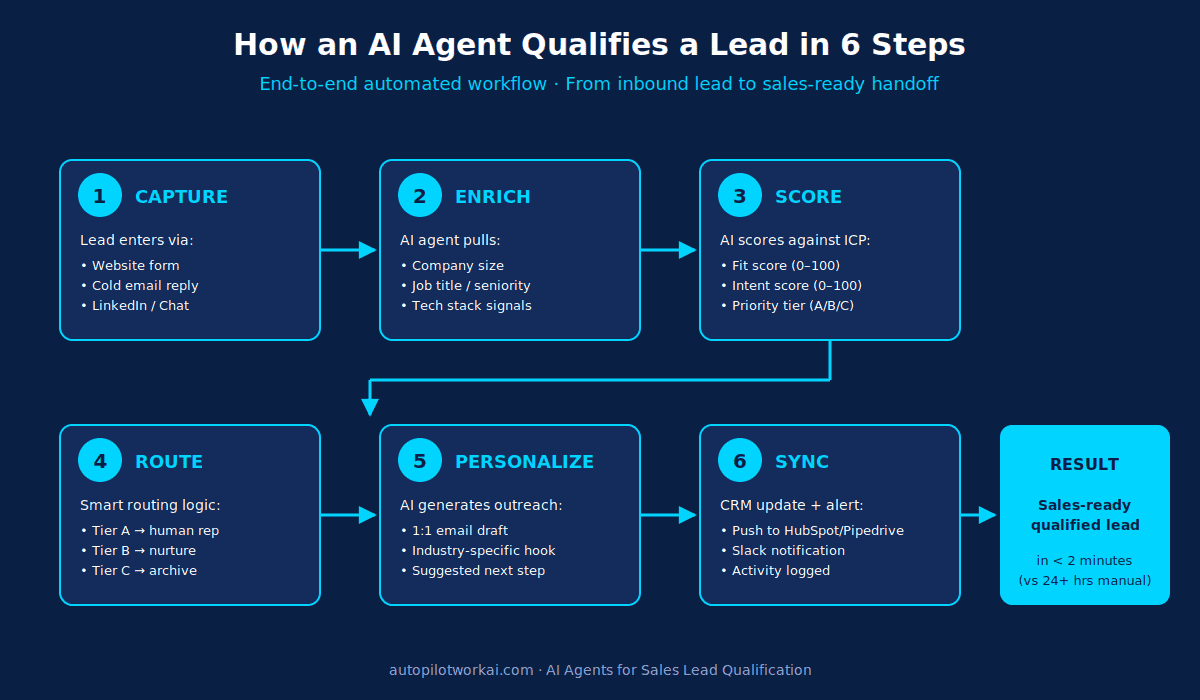
The differences between vendors show up in how well each step is executed. Apollo.io is strong on enrichment because of its 275M+ contact database. Clay shines at custom enrichment chains. Smartlead dominates the routing step with multi-inbox warm-up. Lemlist owns personalization through AI-generated icebreakers. Understanding where each tool wins helps you pick based on which step matters most for your bottleneck.
The 7 Best AI Agents for Sales Lead Qualification in 2026
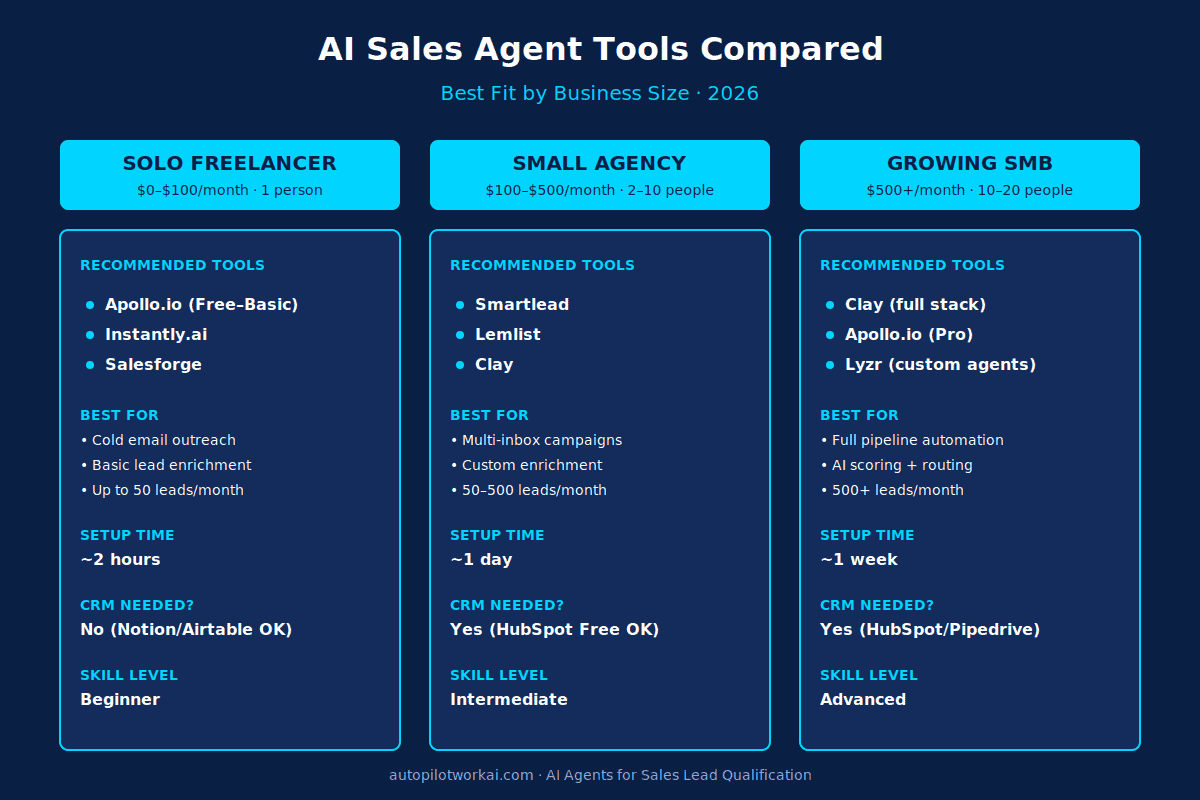
Before the deep-dives, here’s a quick visual snapshot showing which tool fits which business size:
1. Apollo.io — Best All-in-One for Solopreneurs
Pricing: Free plan available · Paid from $49/user/month
Best for: Solo operators who need contacts, scoring, and outreach in one place
Apollo.io combines a B2B contact database with AI-powered lead scoring and sequencing. For solopreneurs, the free tier is genuinely usable — you get 60 mobile credits and basic AI scoring without paying anything. Setup takes around two hours including connecting your email. The scoring engine learns from which leads you mark as qualified, getting more accurate within 2-3 weeks. Visit Apollo.io to see the free tier limits.
Where it falls short: Email deliverability is decent but not best-in-class. Heavy senders should pair it with a dedicated tool like Smartlead.
2. Clay — Best for Custom Enrichment Workflows
Pricing: From $149/month · Free trial available
Best for: Agencies and growing SMBs needing complex enrichment chains
Clay isn’t an outreach tool — it’s an enrichment engine on steroids. You build qualification waterfalls that pull data from 50+ sources, then use AI to summarize, score, and prioritize. The learning curve is real (figure on 1 week to get fluent), but once you’re set up, Clay produces enriched lead lists that no other tool can match. Check pricing at Clay.com.
Where it falls short: Overkill for under-50-leads-per-month operators. Stick with Apollo if that’s you.
3. Instantly.ai — Best for Cold Email at Scale
Pricing: From $37/month
Best for: Freelancers and agencies running cold outreach campaigns
Instantly.ai handles deliverability, warm-up, and AI-assisted personalization in one tool. The AI ICP feature analyzes your existing customers and builds qualification criteria automatically — saving the manual ICP-mapping step. Reporting is clean: reply rate, positive intent, and meeting booked are tracked separately, so you can spot whether your AI is qualifying correctly. See plans at Instantly.ai.
Where it falls short: Limited CRM functionality — you’ll need HubSpot or Pipedrive alongside it for pipeline management.
4. Smartlead — Best for Multi-Inbox Scale
Pricing: From $39/month
Best for: Agencies running 5+ inboxes per campaign
Smartlead’s edge is unlimited inboxes and unlimited warm-up across all plans. For agencies sending high volumes, this is the difference between $39/month and $400/month elsewhere. The AI auto-responder qualifies replies in real-time: positive intent gets routed to a human, objections trigger automated nurture, unsubscribes are handled cleanly. Visit Smartlead.ai for current pricing.
Where it falls short: UI feels less polished than Instantly. If aesthetics matter, factor that in.
5. Lemlist — Best for Hyper-Personalization
Pricing: From $59/month
Best for: Solopreneurs whose differentiation is personalized outreach
Lemlist’s AI generates icebreakers based on the prospect’s LinkedIn activity, company news, or website content. For premium services where every lead matters (consulting, high-ticket coaching, B2B services over $5K), Lemlist’s personalization quality justifies the price. The Liquid syntax lets you build conditional logic without code. See features at Lemlist.com.
Where it falls short: Not built for volume — if you need to send 10,000 emails per week, Smartlead is better.
6. Lyzr — Best for Custom Agent Building
Pricing: Free tier · Paid plans from $99/month
Best for: Tech-comfortable operators who want unique qualification logic
Lyzr is a platform for building your own AI agents — including sales qualification agents with custom logic that off-the-shelf tools can’t replicate. If your qualification criteria are unusual (industry-specific, regulatory, or based on proprietary signals), Lyzr lets you encode that into an agent. It’s the closest thing to “build vs buy” without writing code. For a deeper dive into this path, see our guide on how to build your own no-code AI agent.
Where it falls short: Steeper learning curve than the rest. Budget 1-2 weeks for setup.
7. Salesforge — Best Budget Pick
Pricing: From $40/month
Best for: Solo operators under $5K MRR who need AI SDR functionality cheaply
Salesforge bundles AI personalization, deliverability, and basic qualification into one of the cheapest packages on the market. It won’t match Apollo on enrichment depth or Lemlist on personalization quality, but for under $50/month you get a working AI SDR pipeline. Solid choice for freelancers testing whether AI sales tools fit their workflow before committing to pricier options.
Where it falls short: Limited integrations compared to the bigger players. CRM sync is basic.
How to Choose the Right AI Lead Qualification Tool
Seven options is too many. Use this decision tree to narrow down in under a minute:
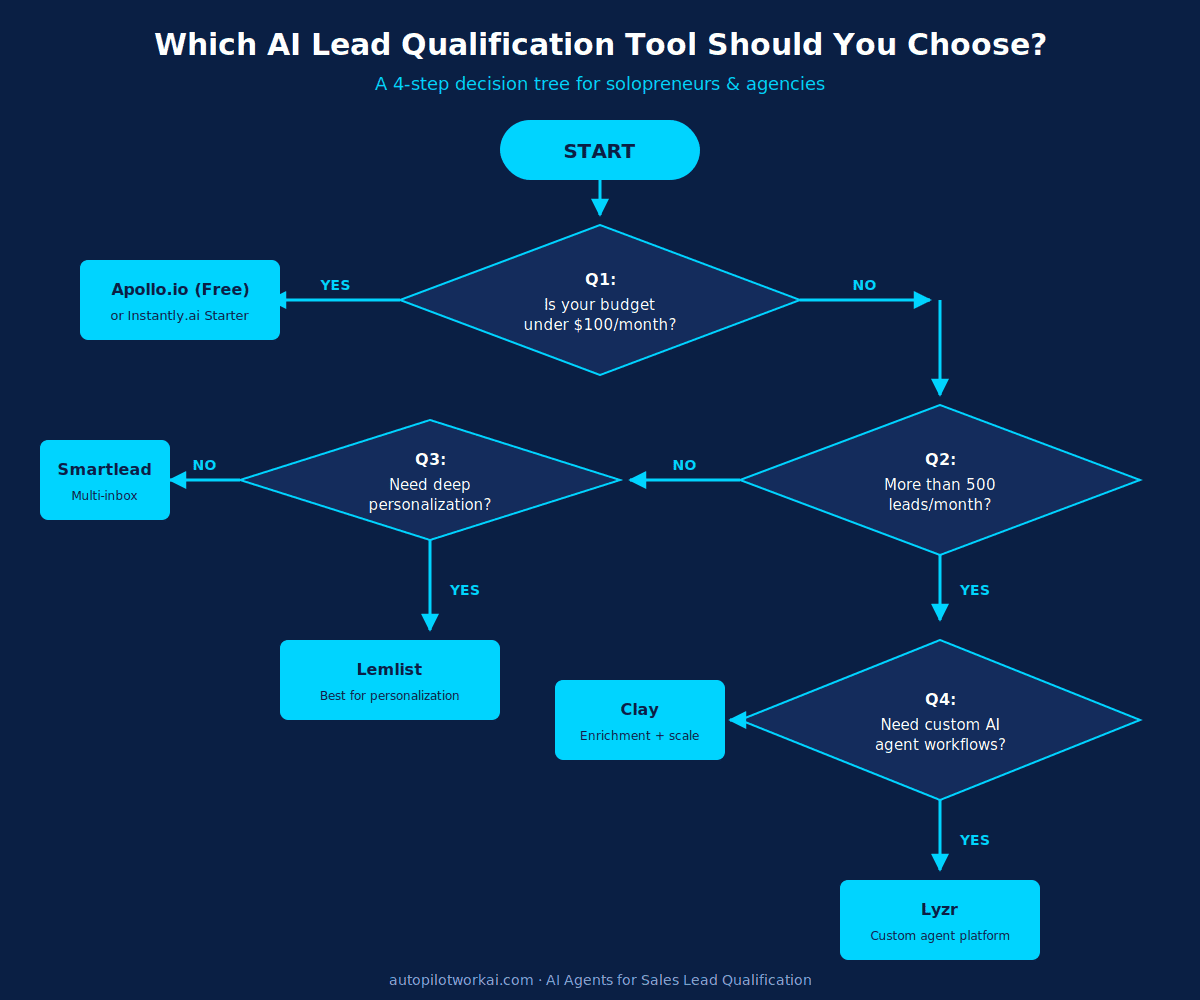
If you’re still uncertain after the tree, default to Apollo.io’s free tier. It costs nothing, takes two hours to set up, and gives you enough signal within 30 days to know whether you need to upgrade or switch tools. Avoid the common mistake of buying the most expensive option first — you’ll waste 80% of the features and burn cash.
Setting Up Your First AI Lead Qualification Workflow
Regardless of which tool you pick, the setup sequence for AI agents for sales lead qualification is the same. Run these steps in order:
- Define your ICP in writing. Three to five non-negotiable criteria (company size, role, industry, geography, tech stack). Without this, the AI has nothing to score against.
- Connect your data source. Forms (Typeform, native WP), inbox (Gmail/Outlook), or CRM (HubSpot Free is fine to start).
- Set scoring rules. Most tools have templates — start with the template, refine after 50 leads.
- Build one routing path. Just one. “Score above 70 → notify me on Slack.” Don’t try to build five paths on day one.
- Run for 2 weeks, then audit. Pull 20 random qualified leads. Were they actually qualified? Adjust scoring weights based on errors.
- Add personalization once routing works. Don’t try to personalize before qualification is accurate — you’ll personalize for wrong-fit leads.
- Connect to automation. Push qualified leads into a follow-up sequence. If you’re new to no-code automation, compare Make.com vs Zapier for solopreneurs to pick the right glue tool.
Total time to a working pipeline: 5-10 hours spread over two weeks. Most operators try to do it in one weekend, get overwhelmed, and abandon. Pace yourself.
5 Common Mistakes to Avoid
1. Buying the enterprise tool when you’re solo. Salesforce Einstein and HubSpot Sales Hub Enterprise are great products — for 50-person sales teams. For one person, they’re a tax on your time and budget. Start with Apollo, Salesforge, or Instantly.
2. Trusting the AI score blindly. No AI scoring engine is right 100% of the time. Audit 20 leads per month for the first quarter and recalibrate. Treat the score as a strong hint, not a verdict.
3. Skipping the warm-up period. If you’re doing outbound, every email sender requires 2-4 weeks of warm-up to land in inboxes. Skip it and you’ll be in spam regardless of how good your AI is.
4. Letting the AI write your replies. AI is great at qualification and openers. It’s mediocre at nuanced replies. Once a lead engages, switch to manual. Hybrid wins.
5. Forgetting compliance. GDPR (EU) and CAN-SPAM (US) apply to AI-generated outreach. Most tools have built-in compliance features, but the legal responsibility is yours. Read the docs.
Frequently Asked Questions
Are AI sales agents worth it for a solo freelancer?
Yes, if you process 20+ leads per week. Below that volume, manual qualification is fine and the tool cost isn’t justified. Above 20/week, even a free Apollo.io plan will save you 5-8 hours weekly. The economic break-even arrives quickly — most freelancers see ROI within the first month.
Can AI fully replace a human SDR?
Not in 2026. AI handles enrichment, scoring, routing, and first-touch personalization extremely well. Reply handling, objection management, and meeting closing still need a human. The realistic positioning is “AI does the 80% of work that’s repetitive, you do the 20% that requires judgment.”
What’s the cheapest reliable AI sales tool?
Apollo.io’s free tier is the most generous entry point — usable for genuinely small operations. If you need more volume, Salesforge at around $40/month covers a basic AI SDR pipeline. Both let you validate the workflow without significant financial commitment.
Do I need a CRM to use these tools?
For solopreneurs handling under 50 active deals, no — Notion or Airtable will do. Once you cross 50 active deals or need pipeline reporting, HubSpot Free is the standard recommendation. Most AI sales tools integrate cleanly with HubSpot and Pipedrive out of the box.
How long until an AI agent starts qualifying accurately?
Expect 30-50 leads before scoring becomes consistently accurate. Most tools have a learning period where they refine the model based on which leads you mark qualified vs. unqualified. Active feedback during the first month accelerates accuracy significantly.
Will Google penalize content marketing that uses AI-qualified leads?
No. Lead qualification happens after the lead reaches you, so it has zero impact on SEO or Google rankings. The relevant penalty zone is AI-generated content used to attract leads, not AI used to qualify them. Different problem entirely.
What’s the difference between lead scoring and lead qualification?
Lead scoring assigns a numeric value (0-100) based on fit and intent signals. Lead qualification uses that score plus context to decide whether a lead is sales-ready, needs nurturing, or should be archived. Scoring is a component; qualification is the full decision process.
How do AI agents for sales lead qualification differ from traditional lead scoring?
Traditional lead scoring is rule-based — you write the rules, the system applies them mechanically. AI agents for sales lead qualification combine scoring with autonomous action: they enrich data, decide on routing, draft personalized outreach, and learn from your feedback. The shift is from “calculator” to “decision-maker.”
The Bottom Line
For solopreneurs and small agencies in 2026, AI agents for sales lead qualification have moved from “nice to have” to operational baseline. The asymmetry that gave enterprise sales teams a structural advantage is closing — a freelancer with Apollo.io’s free plan and two hours of setup now runs a qualification pipeline that would have required a junior SDR three years ago.
Three concrete next steps:
- If you’re under 30 leads/week: Sign up for Apollo.io’s free tier this week. Two hours setup. Done.
- If you’re 30-200 leads/week: Run Smartlead or Instantly.ai for 30 days. Pick the one whose UI you don’t hate.
- If you’re 200+ leads/week or have unusual qualification needs: Invest the week in Clay or Lyzr. The setup pays back within 60 days.
The worst move is paralysis — researching tools for three months while qualifying manually. The qualification game is won by operators who picked the second-best tool in week one over operators who picked the best tool in month four.