
Multi-agent AI systems sound advanced, so most people argue about them instead of testing them. Anthropic actually ran the experiment. A multi-agent AI system — one Claude model directing several specialist subagents — beat a single top-tier model by 90.2% on its internal research eval. The catch: it burned roughly 15 times more tokens than an ordinary chat. That one trade-off is the whole decision in miniature. More agents can mean dramatically better output, or expensive overkill. This guide shows you which side you are on.
TL;DR
- A multi-agent AI system splits one large job across several specialized agents, coordinated by an orchestrator.
- It shines on broad, parallel research and on tasks too large for a single context window.
- It costs far more (about 15× the tokens of a chat) and adds real engineering complexity.
- For most single, well-defined tasks, one well-prompted agent still wins.
- Reach for multiple agents only when a single agent demonstrably can’t keep up, not because the term sounds advanced.
What Is a Multi-Agent AI System?
A multi-agent AI system is a setup where several AI agents work on the same goal at once, each handling a slice of the problem, with a lead agent coordinating the whole thing. Anthropic calls this the orchestrator-worker pattern: a lead agent reads the request, devises a plan, then spins up subagents that each research or execute a separate piece in parallel before reporting back.
Compare that to a single agent, which is one model looping through tools to finish a task from start to end. If you want a refresher on the building blocks, our breakdown of how a single AI agent works under the hood walks through the reasoning loop that drives every agent, plus the tools and memory it relies on. A multi-agent AI system simply takes that unit and runs many copies of it, each with its own focus and its own context window.
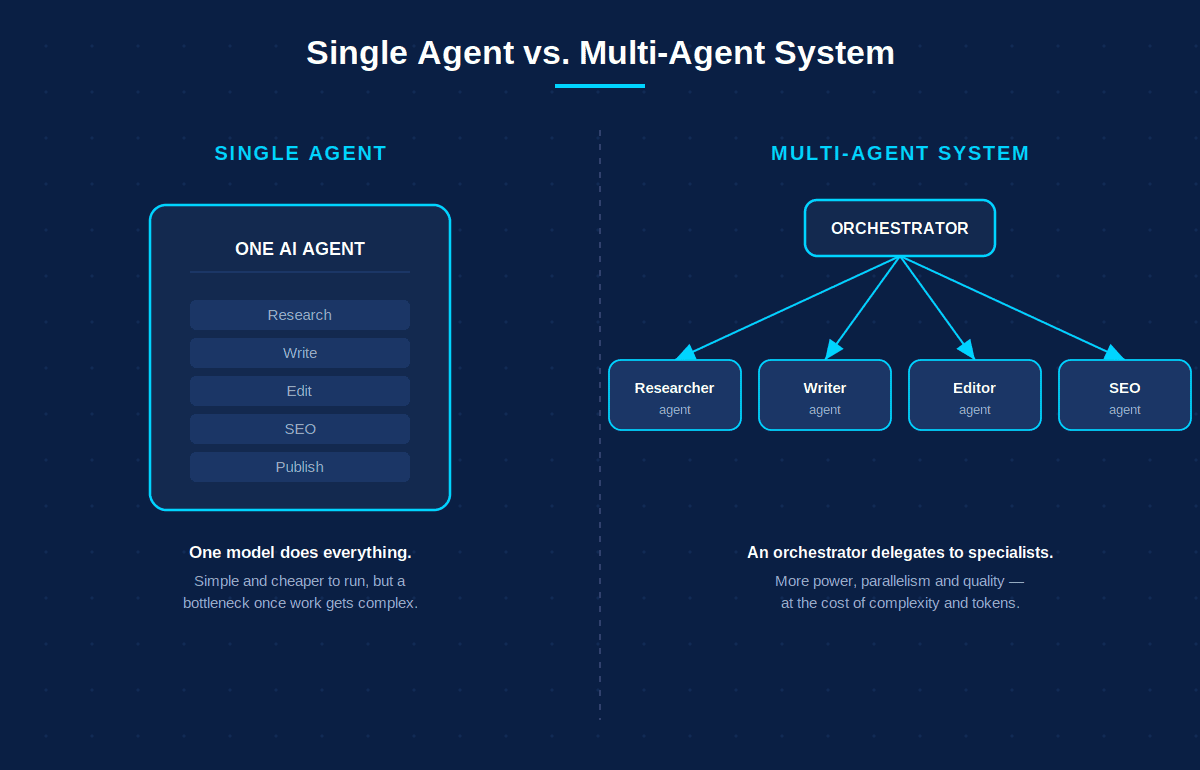
The key word is specialization. One agent researches while another writes, one checks facts while another formats. Because each subagent keeps its own context, the system can process far more information than a lone model could hold in a single 200,000-token window.
Single Agent vs. Multi-Agent AI: The Real Difference
The honest comparison is not “which is better.” It is “which fits the job.” A single agent is cheaper and easier to debug. A multi-agent AI system trades that simplicity for raw capability on problems a single agent cannot fit in its head.
The numbers back this up. In Anthropic’s published multi-agent research system, a Claude Opus 4 lead with Claude Sonnet 4 subagents outperformed a single Opus 4 agent by 90.2% on broad research tasks. The biggest driver was simply token budget: more agents reasoning in parallel meant more compute spent on the problem. The same report puts a price on it, with multi-agent setups using around 15 times the tokens of a normal chat.
A useful rule of thumb from the wider engineering debate: a multi-agent AI system tends to win on reading work such as research, gathering and comparison, while it struggles on tightly coupled writing work like coding, where one agent’s output constantly depends on another’s.
| Factor | Single AI Agent | Multi-Agent System |
|---|---|---|
| Best for | One clear, linear task | Broad, parallel, multi-skill jobs |
| Speed on parallel work | Slow (sequential) | Fast (concurrent) |
| Token cost | Low (~4× chat) | High (~15× chat) |
| Build complexity | Low | High (coordination, evals) |
| Reliability | Predictable | Harder to trace |
| Example task | Draft one email | Research 50 competitors at once |
When You Need More Than One AI Agent
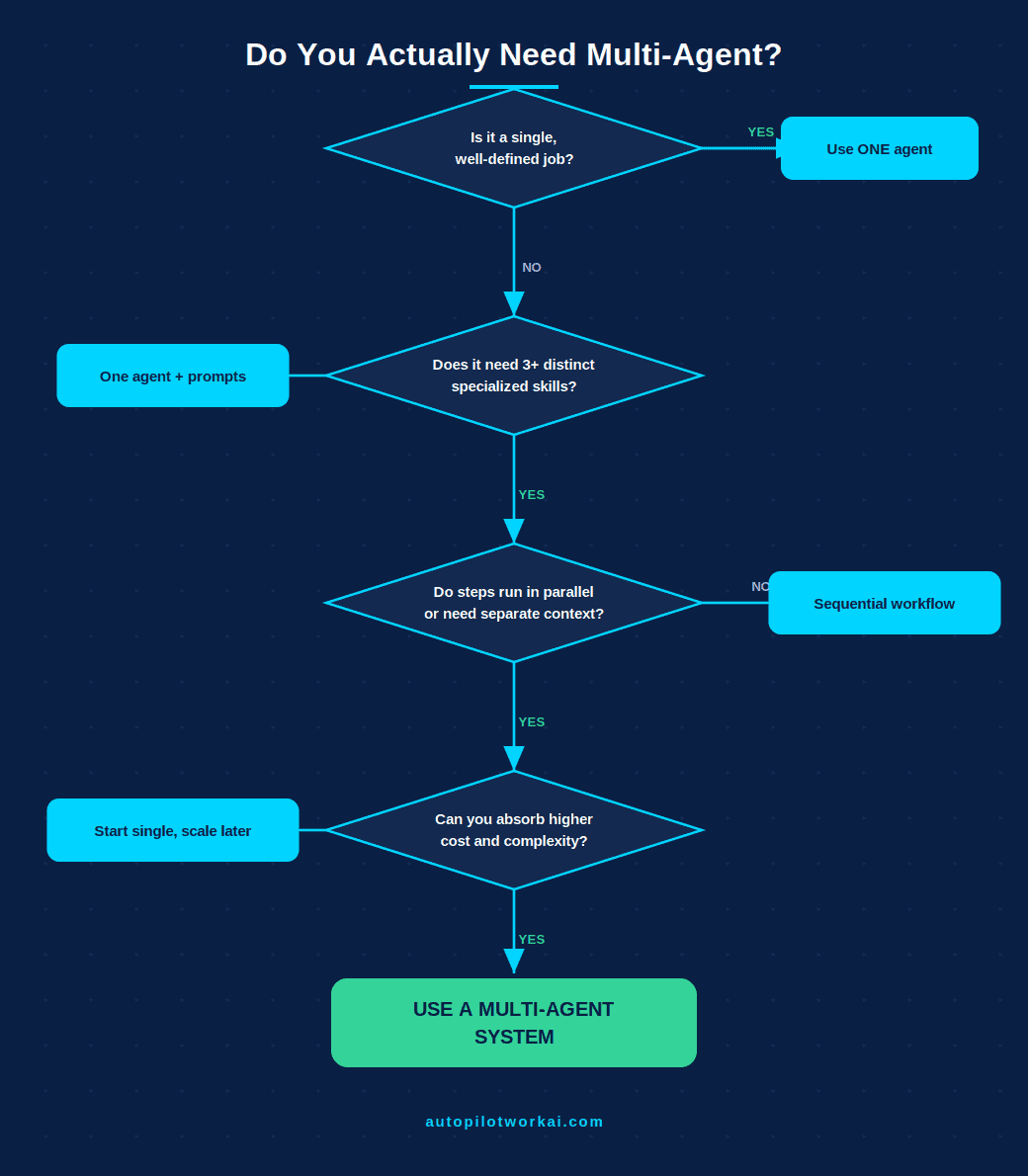
Most solopreneurs reach for a multi-agent AI system too early. The signal to upgrade is not ambition; it is friction. Here are five concrete signs you have outgrown a single agent.
- The task has 3+ genuinely different skills. Work like research and design pulls on separate strengths that one prompt keeps fumbling.
- You keep hitting the context limit. The job needs more documents or data than a single window can hold without truncation.
- Steps can run in parallel. You are waiting on one agent to finish ten independent lookups it could do at the same time.
- Quality drops as the prompt grows. Cramming every instruction into one mega-prompt produces vague, watered-down output.
- The output is worth the spend. A 15× token bill only makes sense when the result earns far more than it costs.
If three or more of these match your situation, a multi-agent AI system is probably justified. If not, you likely need a sharper prompt rather than more agents. For a sense of where this pays off, see our roundup of practical AI agent use cases for solopreneurs.
When a Single Agent Is the Smarter Choice
The loudest voices push complexity, so it is worth hearing the other side. Anthropic’s own guidance in Building Effective Agents is blunt: find the simplest solution that works, and add complexity only when it earns its place. For many jobs that means a single agent, or even a fixed workflow with no autonomous agent at all.
The team behind the Devin coding agent went further, publishing a widely shared piece that argued against multi-agent designs for interdependent work. Their point: when subagents act in isolated contexts, they make conflicting assumptions, and the results clash. One subagent builds a feature the other never knew about. For coding and other tightly coupled tasks, a single context-aware agent is usually more reliable than a committee.
So before you architect a multi-agent AI system, ask whether the problem is genuinely parallel. If every step depends on the last, more agents add coordination cost without adding capability. Plenty of automation never needs an “agent” at all. A simple no-code AI agent build or a basic chained workflow handles a surprising amount of real work.
How a Multi-Agent Workflow Actually Looks
Abstract diagrams hide how ordinary these systems are in practice. Take a content pipeline, the kind a solopreneur runs every week. Instead of one agent juggling everything, a multi-agent AI system hands each stage to a specialist and passes the work down the line.
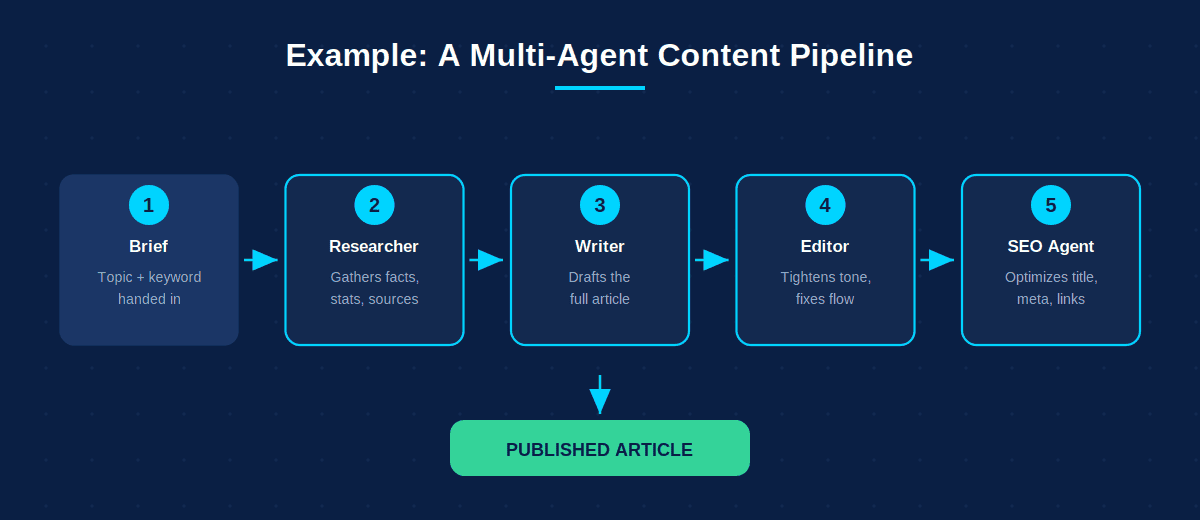
A researcher agent gathers facts and sources. A writer agent drafts from that brief. An editor agent tightens tone and flow. An SEO agent tunes the title and metadata. Each does one thing well, and the orchestrator keeps them in sync. This is not new thinking. Early open-source projects tried it years ago, as covered in our look at early multi-agent experiments like AutoGPT and BabyAGI. What changed is that today’s models follow instructions reliably enough to make the pattern production-ready rather than a demo.
The lesson from the pipeline view is that a multi-agent system is mostly an org chart for software. Define clear roles and clean handoffs under one coordinator, and the complexity becomes manageable.
Tools to Build a Multi-Agent AI System (With or Without Code)
You do not need a research lab to build one. The ecosystem now splits cleanly into no-code platforms for operators and developer frameworks for builders.
No-code platforms for solopreneurs
If you would rather assemble agents visually than write Python, start here. Make.com chains AI steps and tools into orchestrated scenarios, which is close enough to a lightweight multi-agent flow for most operators. Relevance AI is purpose-built for assembling “teams” of AI agents with defined roles and handoffs. n8n gives you self-hostable workflow and agent orchestration with more control over your data. If you are weighing orchestration tools, our comparison of Make.com vs Zapier for solopreneurs is a good starting point.
Developer frameworks
If you write code, three open-source frameworks dominate. CrewAI models agents as a crew with roles and tasks. Microsoft AutoGen focuses on multi-agent conversation and tool use. LangGraph adds stateful graphs for complex control flow. All three are free, and all three assume comfort with Python, so they suit builders rather than pure operators.
Frequently Asked Questions
What is a multi-agent AI system in simple terms?
It is a team of AI agents working on one goal together, with a lead agent dividing the job and coordinating the others. Each agent specializes in a slice of the task, such as research or writing, while keeping its own context. The result is more capacity and parallelism than a single agent can offer, at a higher token cost.
When should I use a multi-agent system instead of one AI agent?
Use multiple agents when a task needs several distinct skills, runs better in parallel, and earns enough to justify the cost. If your job is a single well-defined task that one good prompt handles, a single agent is faster and easier to maintain. The deciding factor is parallelism, not how advanced the setup sounds.
Are multi-agent AI systems worth the extra cost?
Only when the output value clearly exceeds the spend. A multi-agent AI system can use roughly 15 times the tokens of a normal chat, so it fits high-value work like deep research or large-scale analysis. For routine tasks that bill is hard to justify, and a single agent delivers most of the value for a fraction of the cost.
Can I build a multi-agent system without coding?
Yes. No-code platforms such as Relevance AI, Make.com and n8n let you assemble agents with defined roles and handoffs visually. You design the flow, connect your tools, and let the platform handle orchestration. It is the fastest route for solopreneurs who want results without managing Python frameworks or infrastructure.
What is the difference between an AI workflow and a multi-agent system?
A workflow follows fixed, predefined steps in code. A multi-agent system lets agents decide their own path within their roles. Workflows are predictable and ideal for repeatable tasks. Multi-agent systems are flexible and suited to open-ended problems where the right next step is not known in advance. Many production systems blend both approaches.
Do multi-agent systems work well for coding?
Usually not. Coding tasks are tightly interdependent, so subagents working in separate contexts tend to make conflicting decisions that break the build. Engineers behind leading coding agents recommend a single context-aware agent for software work. Multi-agent setups perform far better on breadth-first research, where the pieces are independent.
The Bottom Line
A multi-agent AI system is a power tool, not a default. It can lift output quality dramatically on broad, high-value work, and it can also turn a simple job into an expensive, hard-to-debug tangle. The deciding question is never “does this sound advanced.” It is “can a single well-prompted agent already do this.” Start with one agent. Add more only when you hit a wall you can name.
Want the foundation first? Read how a single AI agent works, get one running on a real task, and scale to a multi-agent AI system only when the job clearly demands it. That sequence saves money and sanity, and it is how the best operators actually build.